Outside Tap Timer Buying Guide: What UK Gardens Need Before You Buy
Buy an outside tap timer with a UK checklist — BSP fit, IP and frost, pressure, outlets and zones — then see when a 4-zone RF smart timer with indoor gateway beats dual digital or WiFi-at-tap.
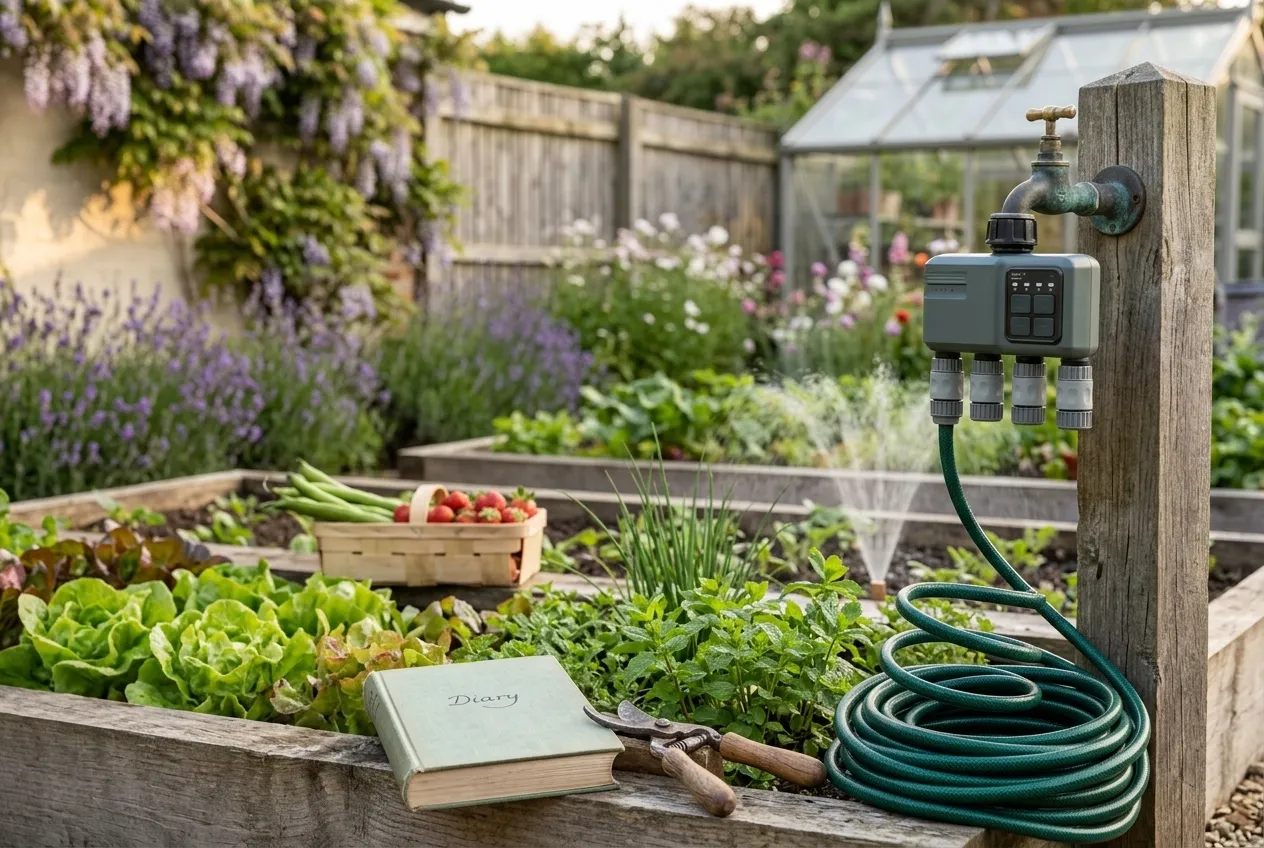
Buy an outside tap timer for BSP fit, a weatherproofing and frost plan, operating pressure (mains versus water butt), and how many outlets or zones your thirst classes need — not for the flashiest app label. A mechanical dial or single or dual digital tap timer is enough for one or two similar areas you are home to manage; upgrade to an RF 4-zone smart water timer with an indoor gateway when pots, borders, lawn and greenhouse want different minutes, or when the outdoor tap sits behind UK brick or a shed where WiFi-at-tap and Bluetooth drop. This is the UK outdoor and outside tap buying checklist — the category home for choosing a tap timer — with the hose or mechanical vs RF decision kept on its own page.
Buy order (keep this sequence): (1) confirm BSP size, washer and hand-tighten fit → (2) lock weather, frost and pressure against your tap or butt → (3) count genuine thirst classes on that one outdoor tap → (4) only then climb mechanical → digital → smart, and only pick a radio path that still reaches the tap. Do not shop “smart” first and reverse-engineer fit, pressure and zones later.
Outside tap timer buy checklist (before you attach)
Before you screw anything onto the outdoor tap, run five practical checks. Most “it won’t open, it leaks, or the app never connects” complaints come from skipping one of them. Fail any hard check (wrong thread, frost with no plan, solenoid on a gravity butt) and the rest of the shopping ladder does not matter.
BSP fit — ¾″ standard, washer, hand-tighten
Most UK outdoor taps take ¾″ BSP. Older taps may be ½″ BSP; larger or commercial outlets can be 1″ BSP. BSP names the nominal bore, not the outer thread diameter — measure across the male thread (about 21 mm for ½″, 26.5 mm for ¾″, 33.3 mm for 1″) or use the adapter set that ships with many UK retail timers. Fit a fresh rubber washer, hand-tighten only (pliers crack housings), and skip metric-only imports that arrive without a BSP path. A timer that cannot seal on your bib is not a bargain at any price.
Weather and frost — IP54+ is rain, not winter
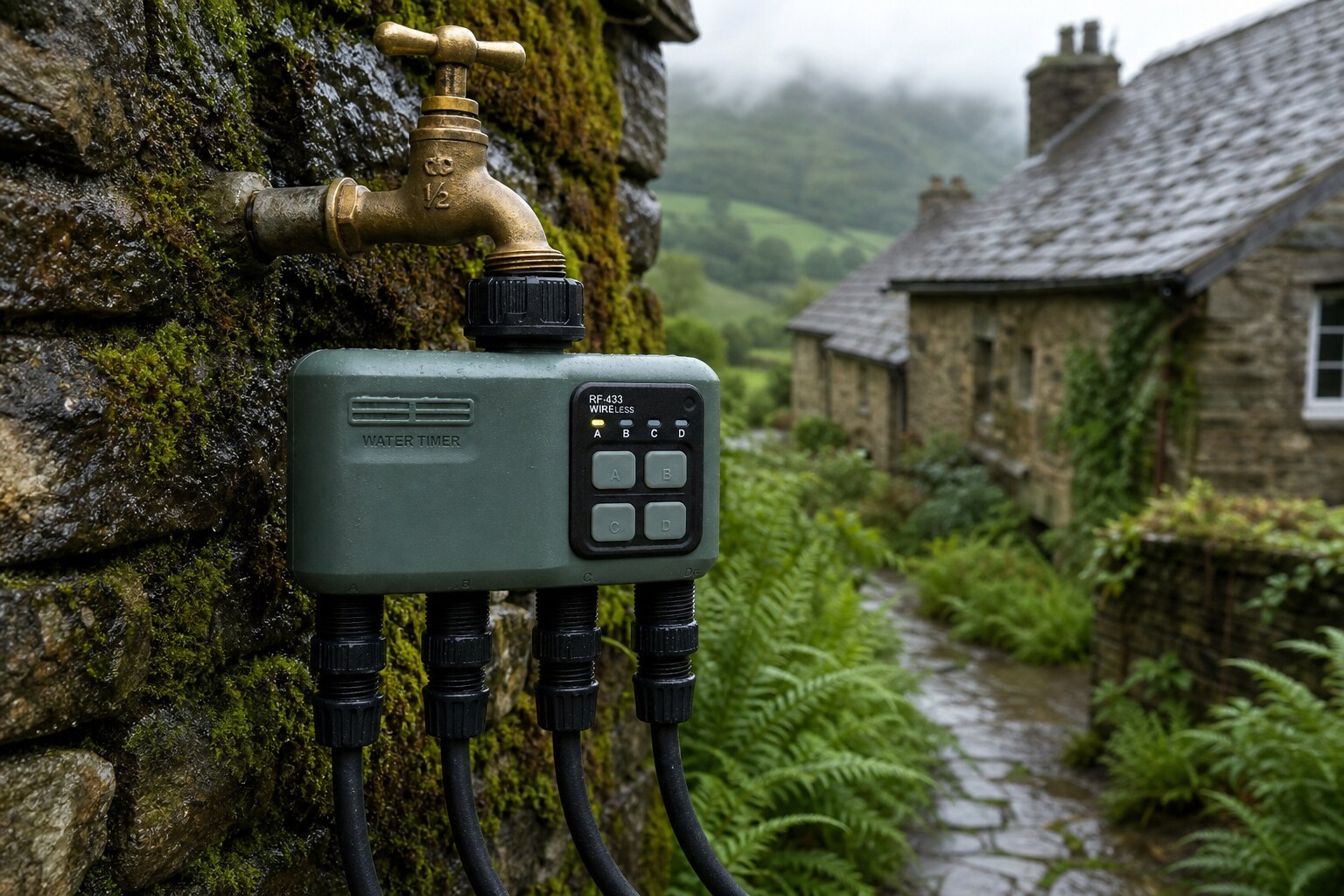
Aim for an IP54+ (or clearer weather rating) for splash and rain. “Weatherproof” marketing is not frost-proof. HydroSure and peers stress water-resistant, not waterproof — prolonged driving rain wants shelter or a temporary bring-indoors. Remove the outdoor tap timer before the first frost, drain standing water, clean the mesh filter, and store frost-free upright. Frost damage is often excluded from warranty. Treat winter storage as part of the purchase decision, not an afterthought in November.
Pressure — mains, solenoid floor, or 0-bar butt
UK mains at the outdoor tap is often roughly 1–3 bar (regional variation). Many solenoid digitals need about ≥0.5 bar to open (Gardena MultiControl Duo lists 0.5–12 bar). Gravity water butts can sit near 0 bar — only buy a SKU rated for butts (Hozelock Select Plus is marketed for P=0 bar, mains max 10 bar). A solenoid on a weak butt fails silently: the schedule “runs”, the valve never opens, and plants dry while the LCD looks healthy. Match the valve type to the supply before you compare app features.
Outlets and zones — match thirst classes
Count how many genuinely different schedules you need — not how many beds you can name. Dual-outlet digitals cover two classes; they are not four. If pots want daily short hits while the lawn wants a longer soak twice a week, dual still forces hose swaps or compromise — that is the upgrade cue toward a 4-zone water timer. Working rule: one thirst class per independently timed outlet. Merging pots and lawn onto one programme always fights on minutes.
Battery, rain delay, manual override
Prefer alkaline or lithium AA (not zinc-carbon or rechargeables on most manuals). Useful extras: rain delay, water-now override, and low-battery lockout so a dying cell does not leave a valve open on holiday. Outdoor AA life is brand-dependent. Holiday cover is a stored-programme and battery problem first; remote app edits are a bonus only if the control path still works from away.
| Check | Pass cue | Fail or upgrade cue |
|---|---|---|
| BSP fit | ¾″ standard plus washer; adapters for ½″ or 1″ | Metric-only import without adapter |
| Weather | IP54+; sheltered if possible; frost remove plan | No frost plan |
| Pressure | Spec covers your mains or 0-bar butt model | Solenoid on gravity butt under 0.5 bar |
| Outlets and zones | Matches thirst classes | Dual still forces hose swaps → RF 4-zone |
| Smart path | Indoor gateway plus RF if tap behind brick or shed | WiFi-at-tap or Bluetooth-only for long UK plots |
| Battery / override | Alkaline or lithium; rain delay plus manual water-now | No low-battery lockout on critical holiday use |
Outdoor and garden tap timer ladder: mechanical to digital to smart
Think of a garden tap timer as a ladder, not a single “best” SKU. Climb only as far as your plot needs. The checklist above decides whether a rung can physically work; this ladder decides how much automation you actually need.
Mechanical egg-timer
Roughly £7–£20, no batteries, twist dial typically up to about 120 minutes. Ideal for one bed, one sprinkler soak, or filling — you must be home to start each cycle. Not holiday-proof. Easy Garden Irrigation-style buyer notes treat mechanical dials as the simplest auto-off, not as cover while you are away.
Digital single
A battery digital tap timer adds start times, duration and frequency. Hozelock Select Plus-class cues include up to three programmes a day, 1–199 minutes, rain delay up to seven days, and water-now override. Still one thirst class on one outlet. A recurring programme does not create zones; it only automates the same outlet.
Dual-outlet ceiling on SERP
“Best sprinkler timer” listicles often crown a dual-outlet digital (RainPoint two-outlet, Gardena MultiControl Duo, Titan dual) as “multi-zone”. Two independent outlets help — lawn plus borders is common — but they are still two classes, not four. Keep the math clear: dual equals two programmes; RF 4-zone equals up to four sequential programmes on one outdoor tap body. Do not treat “multi-zone” marketing as four thirst classes unless the product has four independently timed outlets (or four separate tap units — see the Cloud note below).
When a tap timer is enough vs when you need more outlets
Stay on mechanical or single or dual digital if one or two similar areas cover the garden and you can manage schedules locally. Move up when mixed thirst, holidays, or masonry-blocked apps break that model. If you already hose-swap twice a week to fake “zones”, you have already paid the labour tax that multi-outlet hardware is meant to remove.
| Rung | What you get | Ceiling or break cue |
|---|---|---|
| Mechanical dial | Twist start; up to about 120 min; no batteries | One soak; must be home |
| Digital single | Schedules plus rain delay on better models | One thirst class |
| Dual-outlet digital | Two programmes on two outlets | Still not four classes |
| Bluetooth or WiFi-at-tap | App appeal | Range fails behind masonry or plot edge |
| Indoor gateway plus RF 4-zone | Phone anywhere; sequential A–D on one tap | Soft Johgee path when mixed thirst |
Smart water timer without the WiFi-at-tap myth
A smart water timer only helps if the control path still reaches the outdoor tap when you are indoors, at work, or away. Label language on the box is not the decision — the radio path is. Pass the fit, frost, pressure and zone checks first; then choose the hop that matches your plot geometry.
Bluetooth — phone in range
Phone-in-range Bluetooth is typically about 10–15 m (some Bluetooth tap units cite around 10 m). Brick, sheds and long plots kill that hop. Multi-zone Bluetooth bodies (for example Claber Hydro-4) still need the phone nearby to programme. Bluetooth can still water after you set it face-to-face; it fails the “edit from the kitchen, train or holiday let” job when the tap is out of sight. Do not confuse “schedule runs offline” with “smart control still works”.
WiFi-at-tap — outdoor edge of the router
A WiFi water timer radio bolted to the outdoor unit often sits at the edge of 2.4 GHz router range. UK masonry and long back gardens make “WiFi on the box” a weak promise. You edit schedules when the link holds; you do not want holiday edits to depend on that gamble.
Indoor gateway plus Sub-GHz RF
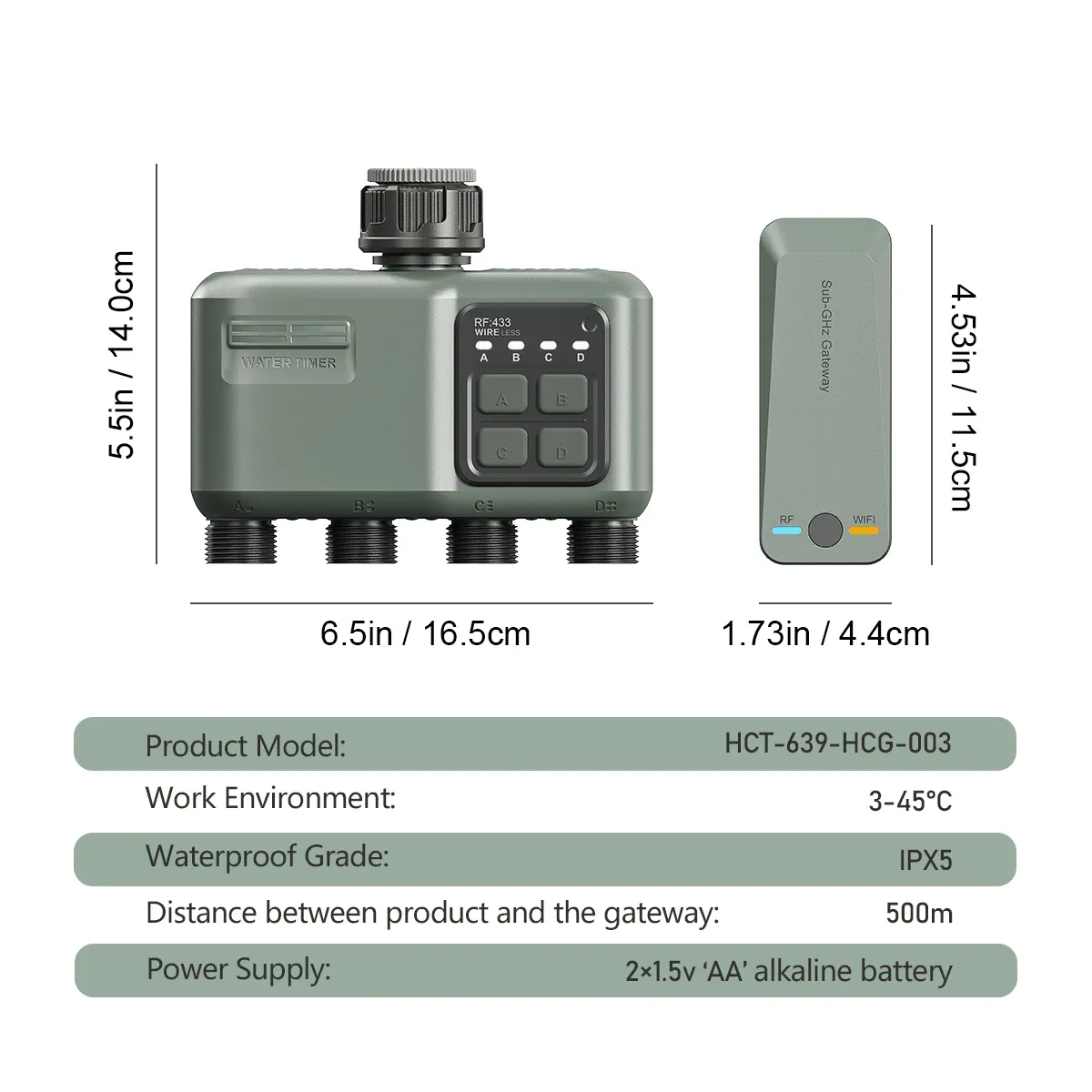
The reliable UK pattern: hub on indoor 2.4 GHz WiFi, outdoor valve on Sub-GHz or Sub-1 GHz RF through walls. Your phone can be anywhere with internet; the hard hop is gateway-to-tap, not phone-to-tap.
Brand note: Cloud four remotes are not one 4-outlet body
Hozelock Cloud pairs an indoor hub (Ethernet to the router) with a remote tap unit up to about 50 m (obstacles reduce range). One hub supports up to four remote tap units — separate taps, not four outlets on one body. Do not confuse that with a true 4-zone water timer manifold on a single outdoor tap. Keep the two upgrade paths distinct before you buy:
| Path | What you get | What you do not get |
|---|---|---|
| Cloud-style hub plus remotes | Up to four tap units on a hub | One body with four hose outlets on a single outdoor tap |
| One 4-outlet RF or digital body | Four sequential outlets on one tap | Four simultaneous full-pressure sprays |
| Type | Control path | UK garden fit | Zone ceiling cue |
|---|---|---|---|
| Mechanical dial | Physical twist only | One bed or soak; no holiday | 1 outlet |
| Battery digital | On-unit LCD or presets | Recurring schedule; still one thirst class | 1 (dual equals 2) |
| Bluetooth | Phone in about 10–15 m | Poor behind brick or shed | Often 1; 4-zone Bluetooth still local |
| WiFi-at-tap | 2.4 GHz at outdoor unit | Drops at plot edge or masonry | Usually 1–2 |
| Indoor gateway plus RF | Hub on WiFi; Sub-GHz to tap | Phone anywhere; punches through walls | 4 sequential on one body |
When 4-zone RF wins — sample upgrade map (A–D)
Upgrade when one outdoor tap must feed three or four independent thirst classes, or when you need reliable app edits through UK brick and sheds. Peers such as RainPoint four-outlet digitals state only one zone valve open at a time, running 1→2→3→4 so pressure holds — the same sequential logic as A→B→C→D. Assign one thirst class per outlet; do not merge pots and lawn onto the same zone because the minutes will always fight.
| Zone | Patch | Why single or dual outdoor tap timer fails | Schedule lean (starter) |
|---|---|---|---|
| A | Lawn or sprinkler strip | Longer soak, fewer starts per week | Longer duration, 2–3× per week |
| B | Borders and beds (drip or soaker) | Different minutes than lawn | Medium soak, fewer cycles |
| C | Patio pots and hanging baskets | Daily short hits in heat | Short, more frequent |
| D | Greenhouse, spare veg or fruit cage | Own humidity or thirst class | Tune to crop; spare if unused |
If you only need three classes, leave Zone D unused rather than inventing a fourth programme that overwaters something.
Run A then B then C then D
Run A then B then C then D — not all four together. Simultaneous open from one tap starves laterals. Sequential is not a limitation of “smart”; it is how one outdoor tap keeps usable pressure on sprinkler, soaker and drip laterals alike.
Soft starter minutes by thirst class
Editorial starters only — finger-test moisture and adjust by season:
- Zone A (lawn or sprinkler): longer runs, fewer days; early morning preferred.
- Zone B (borders): medium soak; avoid matching pot frequency.
- Zone C (pots and baskets): short, more often in warm spells.
- Zone D (greenhouse or spare): crop-led; leave unused if you only need three classes.
Soft next step: Johgee 4-Zone RF Smart Water Timer
Why RF 4-zone beats dual digital for mixed UK gardens
Dual digital solves “lawn plus one other”. Mixed UK gardens often need three or four independent programmes from the same outdoor tap, plus app edits that still work when the tap is out of phone and router sight. Sequential four outlets keep full tap pressure per zone; indoor gateway plus RF keeps the smart path honest outdoors. Upgrade only if the checklist already fired: wrong dual ceiling, mixed thirst, or masonry-blocked control. If one bed and a dial still fit — and BSP, frost and pressure already pass — stay mechanical. That is a valid outcome of this buying guide.
Where the Johgee 4-zone RF timer fits
When the checklist says you need four sequential zones and a control path that punches through UK walls, the Johgee 4-Zone RF Smart Water Timer (olive RF-433 path, zones A/B/C/D, indoor gateway) is the soft upgrade — not another dual digital dressed as “multi-zone”. It screws onto common UK ¾″ and 1″ BSP outdoor taps and programmes four thirst classes from one outside tap without rewriting your hose layout every evening.
Check published fittings and pressure notes on the Johgee 4-Zone RF specifications. No invented star ratings or review scores — verify pressure, range and battery claims on the product page and with on-site tests.
For the hose-vs-RF fork or smart scorecard depth, use the hose or mechanical vs RF decision and the smart water timer review. This page is the outdoor and outside tap buying checklist itself.
Quick answers (FAQ)
Will an outside tap timer fit my UK outdoor tap?
Usually yes. Most UK outdoor taps are ¾″ BSP; many timers include ½″, ¾″ or 1″ adapters. Hand-tighten with a fresh washer — pliers risk cracked housings.
What size BSP thread do I need — ½″, ¾″ or 1″?
¾″ is the domestic outdoor-tap standard; older taps may be ½″; larger or commercial outlets can be 1″. Measure outer thread diameter or use the adapter set that ships with UK retail timers.
What IP rating should an outdoor tap timer have?
Aim IP54+ for splash and rain. Weatherproof is not frost-proof — shelter if you can, and always winter-store.
Do I need to take the timer off before frost or winter?
Yes. Remove before the first frost, drain standing water, and store frost-free. Frost damage is often excluded from warranty.
Will a tap timer work on a water butt or low pressure?
Only if the SKU is rated for 0-bar or gravity (for example some ball-valve digitals such as Hozelock Select Plus). Many solenoids need about ≥0.5 bar and fail silently on butts.
Mechanical, digital or smart — which outdoor tap timer should I buy?
Mechanical for one soak you are home to start; digital for recurring one-class schedules; smart water timer with indoor gateway plus RF when mixed thirst or masonry blocks WiFi or Bluetooth. Run the fit, frost, pressure and zone checks before you pick a rung.
Is a dual-outlet timer enough for my garden?
Enough for two similar thirst classes. Not four — pots daily plus borders weekly plus lawn still need more outlets or hose-swapping. Dual is not a four-zone product under a different label.
When do I need a 4-zone water timer or RF gateway smart timer?
When three or four independent thirst classes share one outdoor tap, or you need reliable app edits through UK brick or shed.
Do WiFi water timers work through UK brick walls?
Often poorly if the radio sits on the outdoor tap at the edge of router range. Indoor gateway plus Sub-GHz RF is the more reliable UK pattern.
Next step
Map lawn, borders, pots and greenhouse to A–D (leave a zone spare if you only need three). If the buy checklist and upgrade cues already fired, check the Johgee 4-Zone RF specifications. For the hose-vs-RF decision or a smart scorecard, use the hose vs RF and best UK smart timers review pages — this guide is the outdoor and outside tap buying checklist itself.
Ready to try Johgee Irrigation?
Shop Now â £84.99