Water Bills Rise Again This April: What Metered Gardeners Should Do About It
Bills rise again in April 2027, the third increase of the 2025-2030 period. What garden watering really costs on a meter, and four fixes ranked by payoff.
Water bills in England and Wales rise again on 1 April 2027 — the third annual increase of Ofwat’s 2025-2030 price review period. The cheapest way to water the garden on a water meter, ranked by payoff: collect rainwater, convert spray to drip, schedule for dawn, and give each zone only the minutes it needs.
Publication note: Water UK publishes its annual average bill change each January; the 2027-28 percentage is added here once that table is live. The advice below stands whatever the exact figure.
The five-year picture, in three numbers
If April’s letter from your water company feels like déjà vu, that’s because it is. Under PR24 — Ofwat’s price review covering 2025 to 2030 — bills were set to rise every year of the five-year period, not once. The track record so far:
- April 2025: the big one. Average household bills across England and Wales rose by 26% — the steepest single-year increase in the industry’s modern history — as the first instalment of a five-year investment programme.
- April 2026: average bills rose a further 5.4%, per Water UK’s official annual table published on 29 January 2026.
- April 2027: the third annual rise under PR24. Water UK’s exact 2027-28 average is published in late January 2027, but the settlement path points to another increase on top of the 26% (2025) and 5.4% (2026) steps.
The direction of travel is not in doubt: PR24 runs to 2030, and each April within it brings another step up. Your supplier’s exact percentage will differ from the national average — the annual Water UK table breaks it out by company, and it is worth looking up yours rather than the headline.
More gardens are on meters every year
The second trend matters as much as the first. Ofwat has announced that by April 2027 the national water meter count will pass eight million, and compulsory metering programmes continue to advance in designated water-stressed areas — much of the south and east. If your home is unmetered today, the direction of policy is that it won’t stay that way indefinitely.
For gardeners this changes the arithmetic personally. On an unmetered bill, a wet July and a profligate sprinkler cost the same. On a meter, every litre through the hose has a price — and the garden is the most visible, most controllable chunk of summer usage.
What watering the garden actually costs
Here is the method, so you can rerun it with your own supplier’s rate — we use £2.2 per cubic metre as a working estimate of a typical metered volumetric rate, and every figure below inherits that “estimate” label. One cubic metre is 1,000 litres. Two numbers matter, not one: most metered bills charge a water volumetric rate (the £2.2/m³ estimate above) and a wastewater (sewerage) volumetric rate on top — often of a similar size. Unless your company grants a garden or soakaway allowance, metered garden water usually carries both, so the combined rate is frequently around £3.5–4.5/m³ (a labelled estimate — check both volumetric lines on your own bill). The worked figures below use the £2.2 water-only rate as a floor; add the wastewater charge again where it applies to you.
A sprinkler, one hour. Garden sprinklers commonly pass something in the region of 10 litres a minute, so an hour is roughly 600 litres — about £1.32 on the water charge alone, and closer to £2–£2.70 once the wastewater charge is added where it applies, every session. Three sessions a week across a dry three-month summer puts the sprinkler alone in the region of £50–£100 as an estimate — for watering that mostly lands on paths and evaporates.
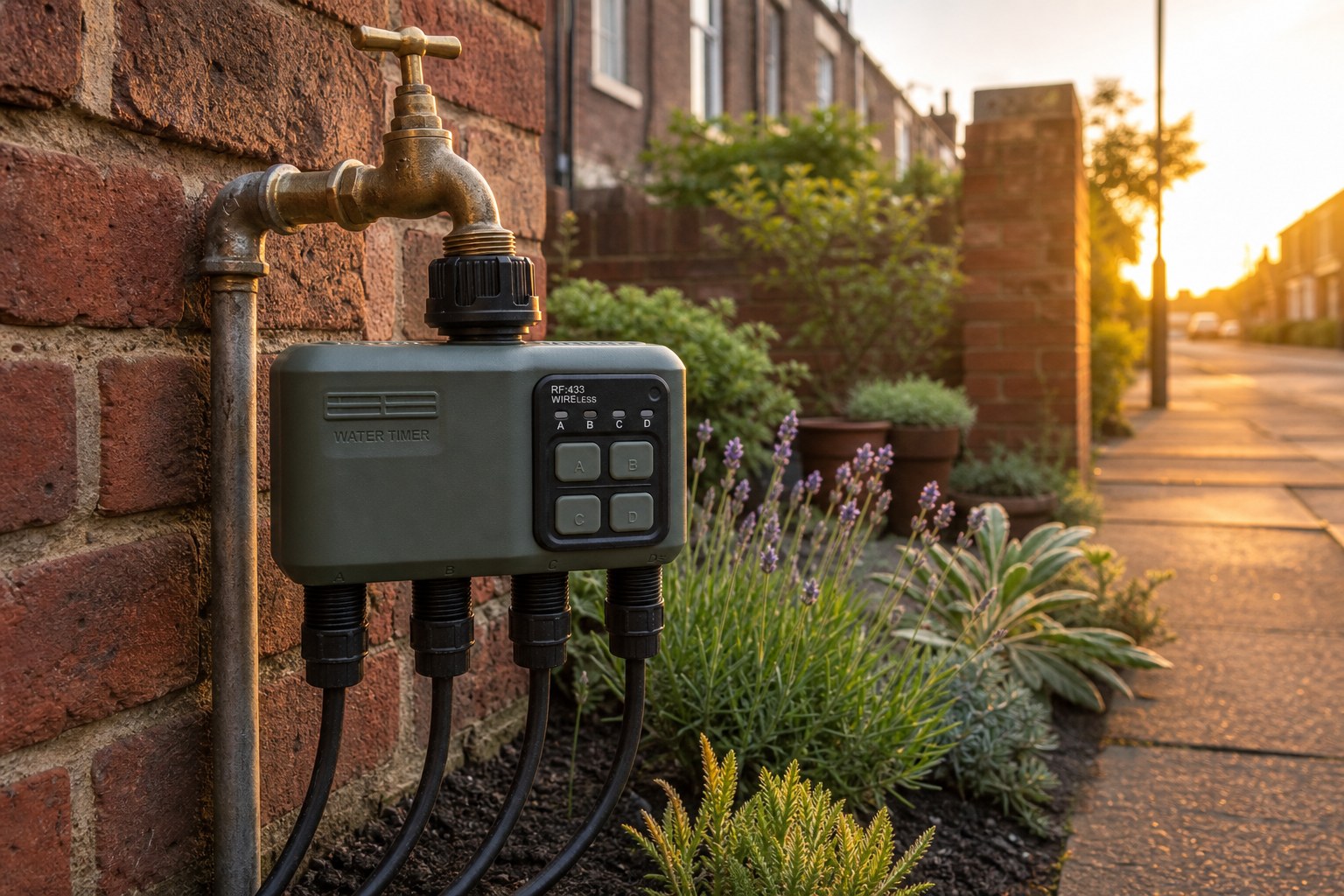
A ten-dripper zone, one hour. Ten drippers at the 4 L/h flow our calculator assumes by default pass 40 litres in the hour — under 9p on the water charge, and still only pennies with wastewater added. That is not a typo; it is the gap between broadcasting water into the air and metering it to roots. Drip carries a second dividend: it is the configuration hosepipe-ban exemptions are written around, with a pressure reducing valve and a timer (the exemption, clause by clause).
A water butt zone, one hour. Zero. Rain fell on the roof for free, and it is outside ban restrictions entirely.
The point is not the pennies; it is the ratio. Moving one thirsty bed from spray to drip cuts that bed’s watering cost by an order of magnitude, and the pattern scales across the garden.
Four responses, ranked by payoff
1. Collect rainwater. The only water with a unit price of nothing. February is the right moment: butts refill through the wettest months, ready for the season — if yours has been drained since autumn, our winter drain-or-fill guide covers recommissioning. One honest caveat: gravity from a butt won’t drive an electric valve timer; a small pump bridges butt and timer, and we’ve published exactly which setup works.
2. Convert spray to drip. The worked example above is the argument. Prioritise the thirstiest zones — pots and vegetables — where the litres-per-week are highest and the payback fastest.
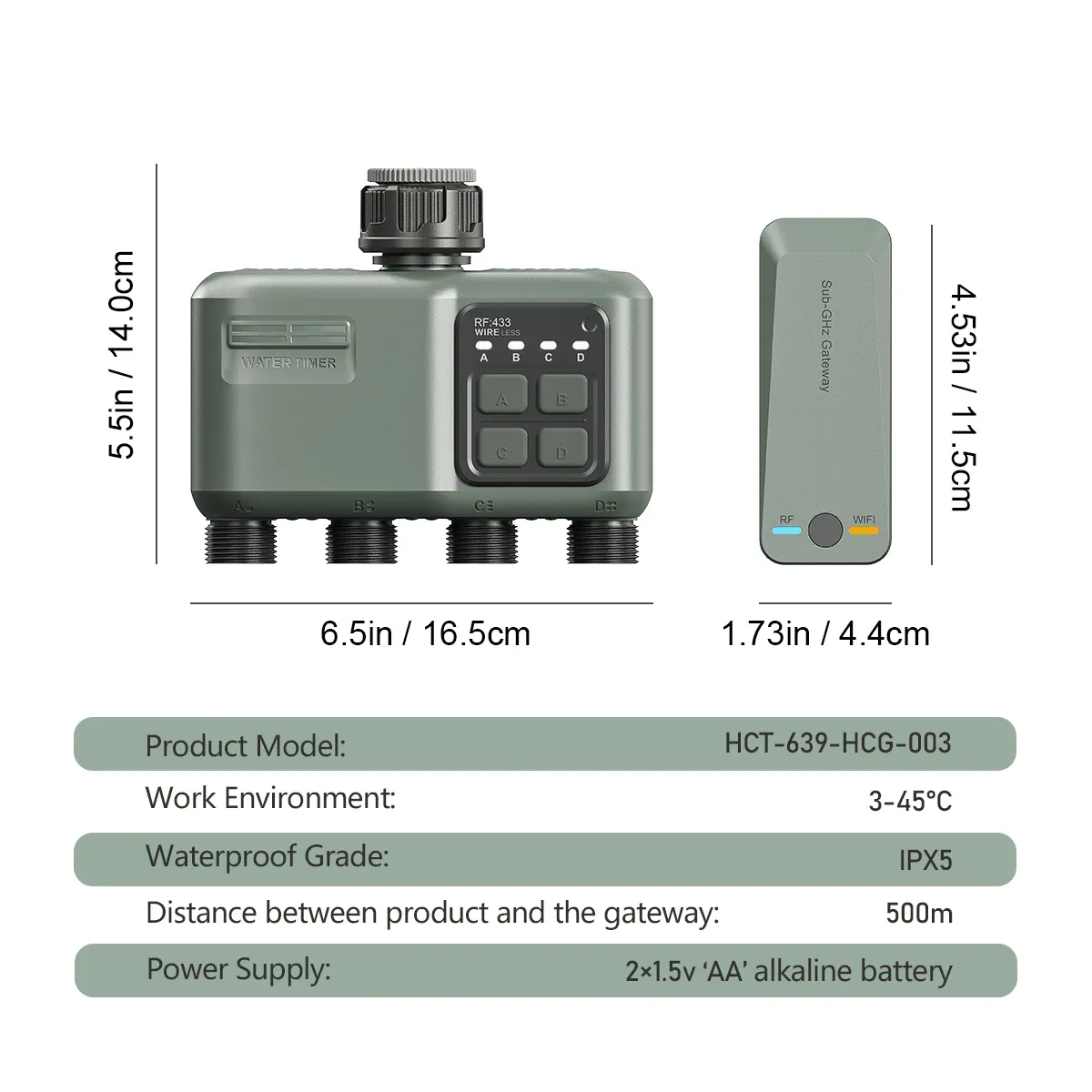
3. Schedule for dawn. Water applied in mid-afternoon sun partly evaporates before it reaches roots; watering you pay for and plants never see. Dawn watering delivers more of each litre where it is going. On a timer this costs nothing to fix — set the schedule once (specifications and scheduling); on manual watering it costs you your lie-in, which is why it rarely survives July.
4. Zone discipline. The quiet money-saver: stop giving every plant the average. Borders need a fraction of what pots need; a lawn wants rare deep soaks, not a daily sprinkle. Run each zone for the minutes its planting and soil actually require — the watering duration calculator turns area, planting and soil into minutes per session and sessions per week, and it prices the weekly usage with the same estimate rate used here, so you can see the cost of a schedule before you set it.
Do all four and a metered garden stops being a summer anxiety. The rainwater fraction is free, the mains fraction is drip-fed at dawn in measured minutes, and the meter reflects it.
Who shouldn’t bother
Honesty corner: if your home is unmetered, you have no plans to move, and your supplier has not written to you about compulsory metering, the sums above don’t change your bill — unmetered charges don’t move with usage. Water-efficient habits remain good citizenship, and drip remains the ban-proof way to water, but nobody should sell you plumbing on savings your tariff cannot deliver. Check which side of that line you are on before you spend; if metering is in your postcode’s future — and Ofwat’s expansion figures suggest for most it is — everything above applies, just on a delay.
Get 10% off your first order. Join the email list on the product page and we’ll send a genuine 10% first-order code for the Johgee 4-Zone timer — plus the updated cost tables when the April rates land. Real discount, no deadline, no pressure.
Ready to try Johgee Irrigation?
Shop Now â £84.99