Tomato Watering Schedule for Grow Bags & Raised Beds (Timed Zones, UK)
Outdoor UK tomato watering schedule for grow bags, raised beds and patio pots — weather bands, litres, and a dedicated 4-zone RF timer programme.
Outdoor tomatoes — grow bags especially — need a steady tomato watering schedule, not feast-and-famine soaks that invite blossom end rot and split fruit. Start from UK weather bands (cool / warm / hot) for how often to water tomatoes and roughly how many litres per bag or plant. Water compost at the base so foliage stays dry, then put tomatoes on a dedicated zone of a 4-zone RF timer. Convert litres into minutes with a simple rule — minutes × dripper L/h ≈ litres per plant — and tune every programme by finger test, not by a forever calendar. Raised beds usually want fewer, deeper soaks than bags or patio pots, so do not share the tomato zone with lawn spray or hanging-basket bursts.
How often to water tomato plants outdoors in the UK
How often to water tomato plants outdoors is a weather-linked rhythm, not a fixed calendar date. The RHS advice is to keep soil or compost evenly moist: swings between bone-dry and flooded are what push fruit splitting and blossom end rot. Simply Seed’s practical UK baseline — every two to three days for many plants in open ground, daily (or more) for containers in warm weather — matches what most patio and allotment growers see once fruit is swelling.
Finger test beats a rigid calendar
Push a finger a few centimetres into the compost or soil. If it feels dry at that depth, water; if it is still moist, wait. Curling leaves can be an early thirst signal. Grow bags and patio pots dry far faster than raised beds or open ground because the root zone is small and exposed, so check them daily in summer even when a printed schedule says “every other day”. Automation does not retire that check — it only removes the daily hosepipe chore once the zone minutes are close.
Cool / warm / hot weather bands
Use these outdoor UK bands as starting cues for how often to water tomatoes, then confirm with the finger test:
| UK conditions | Hand-water cue |
|---|---|
| Cool / cloudy (under about 18°C) | Check daily; often every 1–2 days |
| Warm / sunny (about 18–25°C) | Often daily |
| Hot (above about 25°C) / windy | Once or twice daily — prefer short splits |
| After heavy rain | Pause or reduce; beds can pause longer than bags on hardstanding |
Morning vs evening (blight and leaf wetness)
Water compost or soil only — never a spray over the canopy. Morning is preferred so any splash on lower leaves dries before evening. Prolonged leaf wetness is the hygiene risk for late blight outdoors in warm, humid spells; base watering is a habit, not a cure. If you must water later in the day, keep the flow at the root zone and avoid leaving foliage wet overnight.
Grow bags, raised beds and patio pots need different rhythms
One schedule cannot serve every tomato site. Shallow grow-bag compost wants short, frequent drinks; raised beds and open ground prefer deeper, less frequent soaks; patio pots behave much like bags. Litres below are bag or plant totals for a day (hand-water or drip sum). Timer minutes later must add up to those totals at your dripper rate — otherwise the weather band and the dial contradict each other.
Grow bags: short, frequent cycles and litre cues
A standard grow bag holds roughly 33–40 litres of compost but often only about 10–12 cm of depth, so there is little moisture reserve. In warm weather, treat watering as a daily check. Editorial outdoor litre starting points (Garden UK grow-bag guidance, tuned on-site) are roughly 2–3 L per bag once on cool or cloudy days, 4–6 L once or twice when warm, and 6–10 L split morning and late afternoon when hot. Growplot-style plant cues of about 1–2 L per plant per day in normal weather and up to 3–4 L in heat are useful cross-checks when you run one stake per plant. Put one dripper stake at each plant position so water soaks in rather than running off the bag surface. If compost has dried hard, a short first soak may need a second pass after twenty minutes so the media rewets evenly — lengthen the zone later rather than dumping one double-volume blast.
Raised beds and open ground: deeper, less frequent soaks
Outdoor tomatoes in raised beds or ground usually cope with a deeper soak every two to three days in average UK summer weather, adjusted for rainfall and soil type. That is a different programme from grow bags — longer run times, fewer starts. This page stays on schedule only; for layout and pipework, follow the raised-bed drip irrigation setup guide. Do not copy grow-bag start counts onto a bed lateral and expect the same moisture pattern.
Patio pots: treat like bags
The RHS suggests one tomato plant in a 30–45 cm pot. Match dripper count to plant count. Large pots buffer moisture better than grow bags, but on a hot patio they still need frequent checks. Do not put thirsty patio tomatoes on the same long lawn programme as turf.
Two plants per grow bag
Plant two tomatoes per standard growing bag, not three. Denser planting pushes daily litres, dries the bag faster, and makes even moisture harder to hold — exactly when blossom end rot risk rises. With two plants and two stake drippers on one zone, bag litres ≈ the sum of both emitters for that day’s starts.
Blossom end rot and blight: consistency and base drip
Irregular moisture leads to blossom end rot
Blossom end rot is a calcium delivery failure inside the fruit. The RHS is clear: compost and soil almost always contain calcium; the problem is inconsistent moisture so calcium never reaches the fruit tip. Grow bags and pots are most at risk. In heat, watering two or more times a day is better than one double-volume dump. Once grow-bag compost has dried hard, it is difficult to rewet evenly. Automatic watering is an RHS-listed option when hand watering cannot keep that rhythm — the point of the tomato zone is steadiness, not higher peak flow.
Keep foliage dry
Late blight needs prolonged leaf-surface wetness. Outdoor plants take the highest weather risk in warm, wet UK summers. Base drip (or careful can watering at the compost) keeps foliage dry as a hygiene habit. Watch humid spells as an editorial cue to check your schedule — this is not a blight-treatment guide.
Put tomatoes on their own 4-zone timer programme
The labour fix for a tomato watering schedule is not a longer hosepipe session on Sundays. It is short, frequent base drip on a dedicated zone, while lawn, borders and hanging baskets keep their own programmes. Sequence zones so the tomato lateral runs alone while Zone A is open; do not assume four outlets can share one outdoor tap at full pressure together.
Why tomatoes, lawn and hanging baskets need separate dials
Lawn spray wants longer, less frequent runs. Hanging baskets want many short bursts. Outdoor tomatoes in grow bags want something in between: often one or two cycles a day in summer, long enough to hit the litre band without base run-off. A single mechanical dial cannot hold those three rhythms. That is the practical reason for a 4-zone RF controller with zones A–D.
Soft starter programmes (minutes × ~2 L/h)
Assume common UK kit stake drippers around 2 L/h (catalogue class, not a published Johgee flow claim). Delivery maths first, then weather:
minutes × (L/h ÷ 60) ≈ litres per plant per start
Example: 45 minutes × 2 L/h ≈ 1.5 L per plant. Two plants in one bag ≈ 3 L to the bag for that start.
Editorial starters for outdoor bags and pots (one stake per plant; scale by finger test and soak-in — not factory guarantees):
| UK conditions | Zone start idea (bags/pots @ ~2 L/h) | Rough daily aim |
|---|---|---|
| Cool / cloudy (under about 18°C) | 1× morning, about 30–45 min (or two shorter splits) | Toward ~2–3 L/bag with two plants |
| Warm / sunny (about 18–25°C) | 1× morning about 45–60 min; add a short afternoon if mid-day dry | Toward ~4–6 L/bag |
| Hot (above about 25°C) / windy | 2× cycles (morning + late afternoon); often about 45–75 min each, or more shorter splits with the same daily total | Toward ~6–10 L/bag |
| Raised beds | Longer single morning run, fewer starts | Deeper soak; not bag minutes |
| After heavy rain | Skip or shorten the next start | Beds pause longer than bags on hardstanding |
A short 8–12 minute first run is only a soak-in probe: if water pools or exits the bag base, shorten or split; if compost is still dry a few centimetres down, lengthen toward the litre band above. Garden UK’s common peer cue of about 15–20 minutes, twice daily in peak summer with drippers at each planting position is useful context at ~2 L/h (roughly 1 L per plant per day before you stretch minutes in heat) — still tune by soak-in and finger test, not as a forever programme.
Feeding the Johgee 4-Zone RF timer (zones A–D)
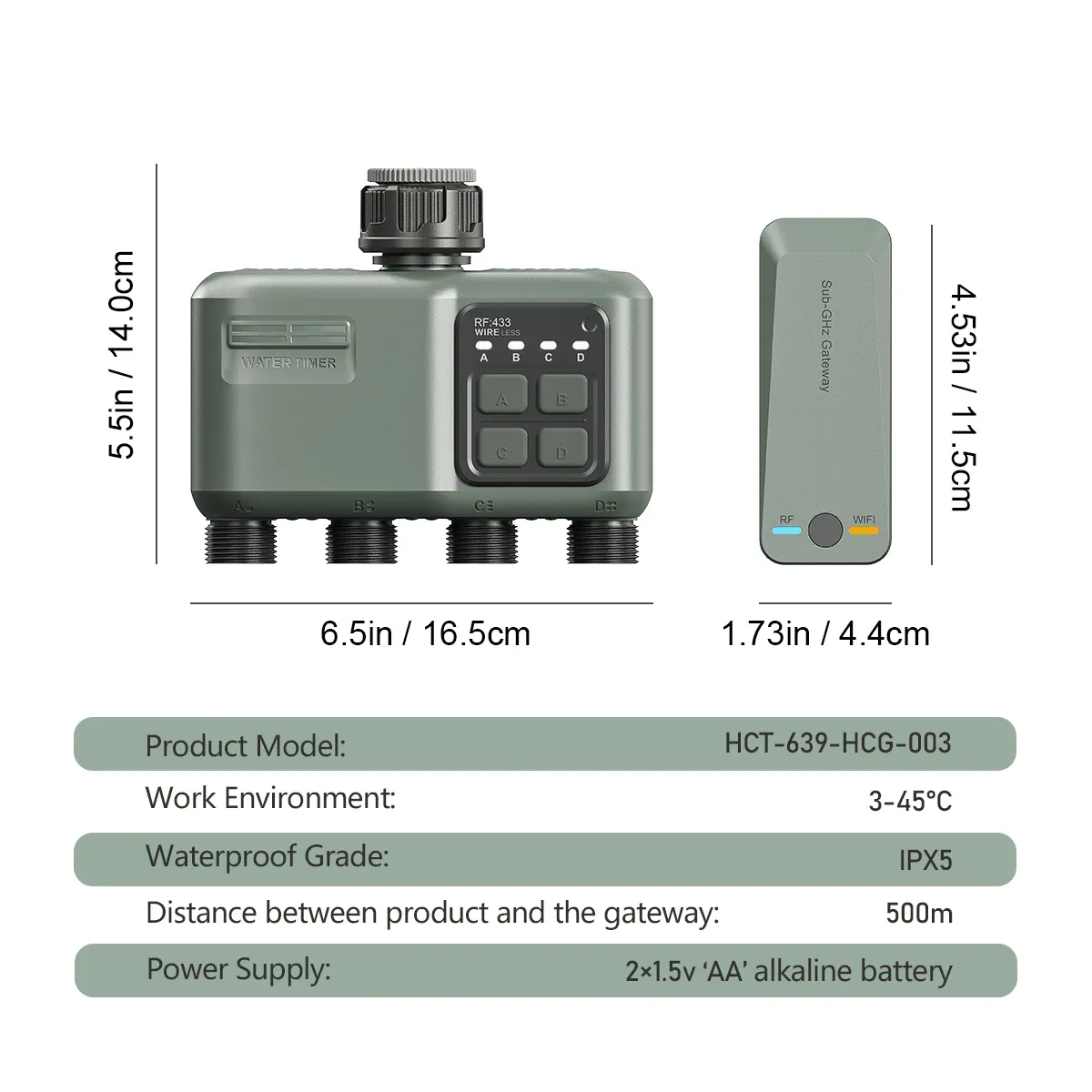
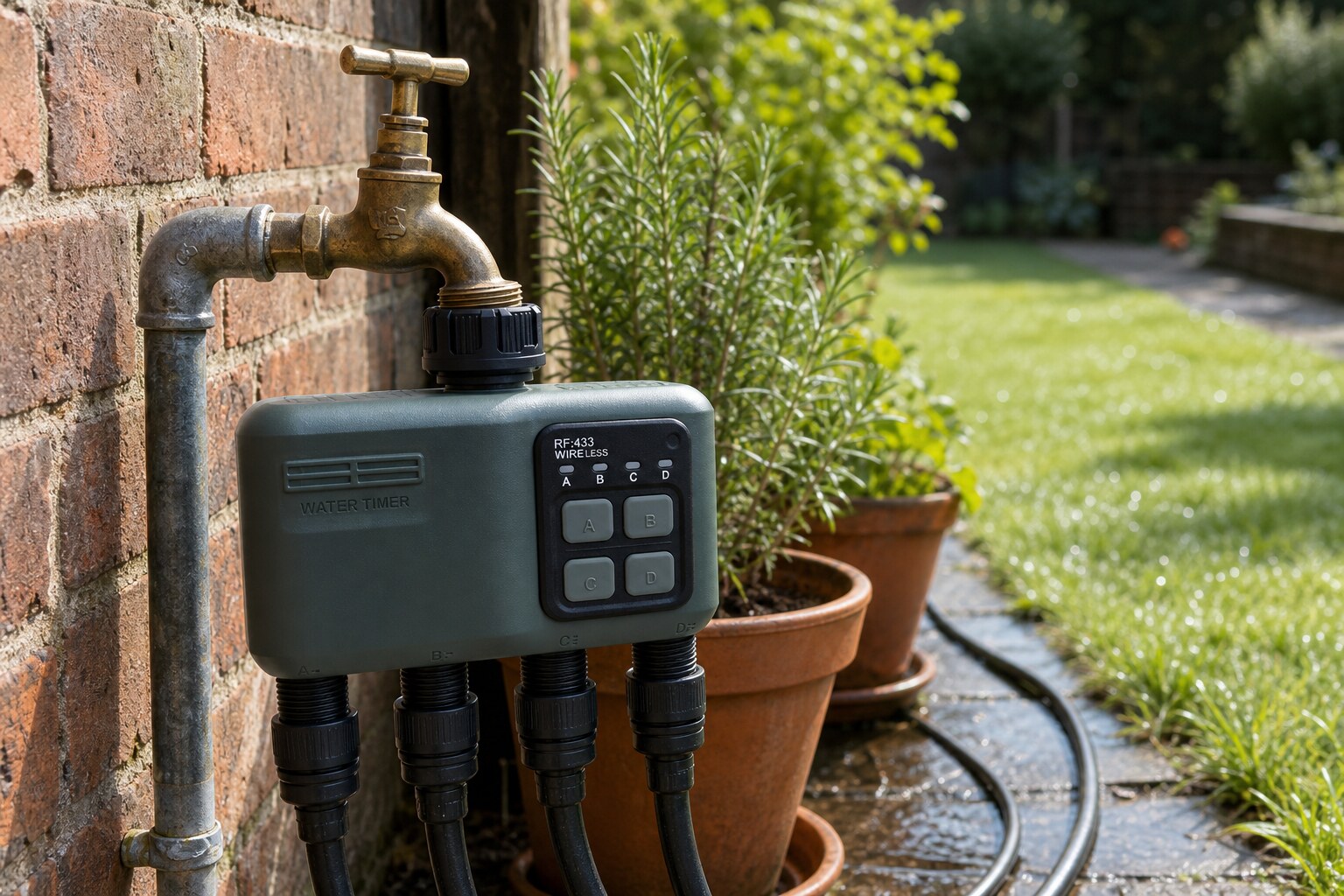
Assign outdoor tomatoes to one zone (for example Zone A) on the Johgee 4-Zone RF Smart Water Timer (olive RF-433, zones A/B/C/D). Use Zones B–D for lawn, borders or baskets with different duration and frequency. Run programmes sequentially (A then B then C then D) so one outdoor tap keeps usable pressure on the tomato stakes. Check the Johgee 4-Zone RF specifications for current hardware details — no star ratings or review quotes here; programmes above are editorial starters pending factory confirmation.
Layout cue: tap → timer → filter/PRV → micro-drip
Outdoor tap → Johgee 4-Zone RF timer → filter/PRV → supply → T
  → micro tube → stake dripper at each tomato (base only)
Keep emitters at the compost surface, not aimed at leaves. Filter and PRV sit after the timer in this editorial cue so grit and excess mains pressure are managed before fine stakes — confirm what your kit and tap need. This is a schedule-and-zone cue, not a full install walkthrough.
Quick answers
How often should I water tomato plants in a UK summer?
Check below the surface daily. Cool spells may stretch to every one or two days; warm weather is often daily; heat and wind often mean once or twice with short drinks. Consistency beats a rigid calendar.
How often should I water tomatoes in grow bags?
More often than ground plants: shallow compost dries fast. Warm weather usually means daily; hot spells often want morning plus late afternoon. Prefer two plants per bag and short drip cycles that still add up to the day’s litre band, not one long flood.
How many litres does a tomato grow bag need per day?
Editorial outdoor starters: about 2–3 L on cool days, 4–6 L when warm, and 6–10 L when hot (often split). Tune until compost is moist several centimetres down without run-off from the bag base.
Should I water once or twice a day in a heatwave?
Often twice (or more short splits) for bags and pots. The RHS notes it is better to water twice a day than once with double volume when blossom end rot risk is high.
Does watering the leaves cause tomato blight?
Wet foliage for long periods raises late-blight risk outdoors. Water compost at the base; prefer morning so splashes dry. Drip stakes help keep leaves dry — they do not replace good spacing and humid-weather vigilance.
How long should I run a drip timer on tomato grow bags?
Use minutes × ~2 L/h to aim at the day’s litres (for example about 30–60 minutes once, or two shorter cycles, in ordinary warm weather; longer or split further in heat). A peer summer cue of about 15–20 minutes twice daily is a starting context only. Adjust by finger test.
Can one outdoor tap timer water tomatoes differently from the lawn?
Yes, with multi-zone control: a tomato programme on one zone; lawn and borders on others. Prefer sequential starts so the tomato zone runs alone while it is open. That is the core reason to choose a 4-zone RF timer over a single dial. See also the timer and install FAQs.
Next step
Put outdoor tomatoes on Zone A with base-drip cycles sized to your litre band, then check the Johgee 4-Zone RF specifications. For timer questions, use the FAQ; for wider patch context, see allotment irrigation. Treat every minute figure as a starting point until you have confirmed pressure, run times, concurrent-zone behaviour and after-rain edits for your kit.
Ready to try Johgee Irrigation?
Shop Now â £84.99